 Neto Gregório
Age of the Bible: the Bible strategy game I'm making
This blog has always been a place for sermons, Bible studies and sermon outlines. Today I want to share something different: I'm making a Bible game. It's called Age of the Bible, it's a project sponsored by Midvash, and you can already play it for free in your browser. If you'd rather jump straight in, the Bible game Age of the Bible is live.
The idea came from a simple question: why do kids spend hours building villages and training armies in mobile games, yet almost never meet the stories of the Bible at that same level of quality? I decided to answer that question the most practical way I know: by building the game.
Is there a Bible strategy game?
There is, and I'm making one. The quickest way to explain Age of the Bible is to call it a "Bible Clash of Clans". If you've never played Clash of Clans: it's a strategy game where you build your base, gather resources, train troops and head out to battle.
Most of the Bible games I know are quizzes, word searches or memory games. They have their place, but I wanted a real Bible strategy game, one that holds kids' attention the same way the games they already play do, and teaches the story along the way.
How does Age of the Bible work?
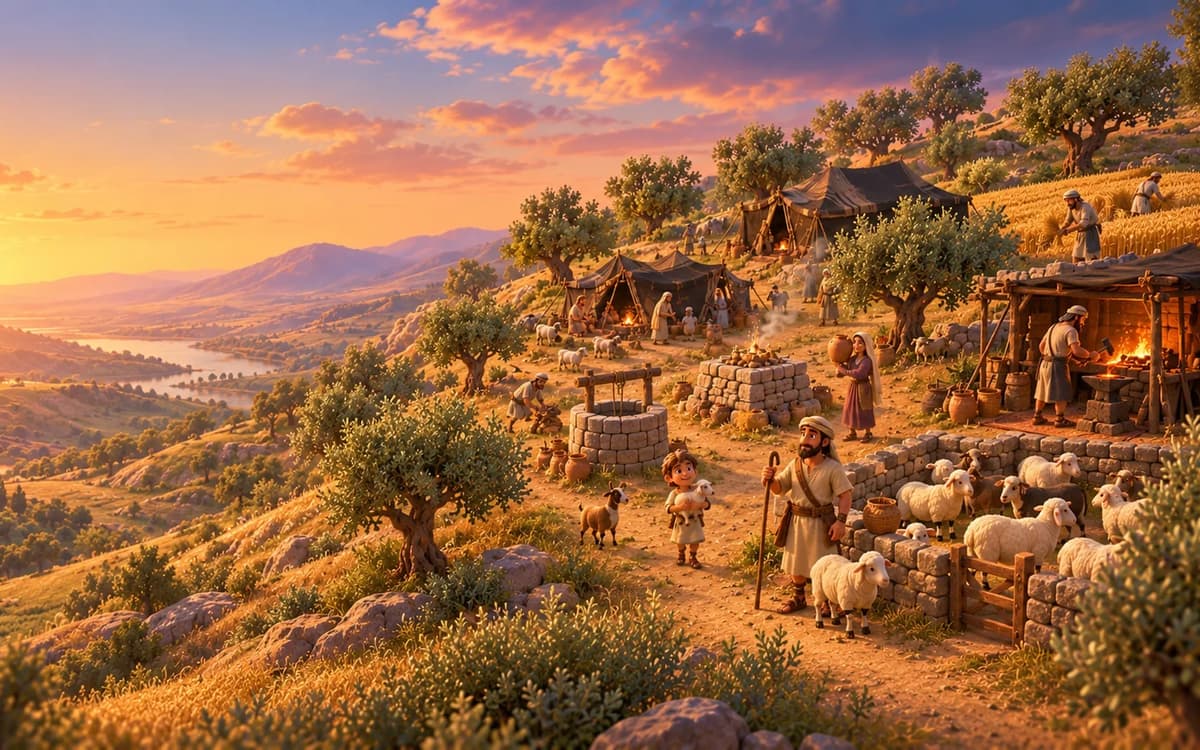
In the game, you are the head of a household in the days of Genesis. You start small and raise your village piece by piece: goat-hair tents, a sheepfold, a grain field, a quarry, a well, a forge and a stone altar.
Crafts the Bible itself describes
One of my favorite parts is the crafts. I didn't have to invent a tech tree, because Genesis already tells us who started each thing. Jabal is the father of those who live in tents and raise livestock. Jubal is the father of those who play the harp and flute. Tubal-cain worked bronze and iron. And Noah built the ark out of gopher wood.
In the game, you learn these crafts and, along with them, meet the people the Bible places at the beginning of each one. A child learns to make tents and finds out who Jabal was.
Mighty men and battles
Once your village is standing, you train your mighty men: slingers and spearmen. Then you march out against the ancient peoples that appear in the text: the Philistines of Gerar, the Canaanites of Shechem and the Amorites of Hazazon-tamar.
One decision I made right at the start: players never fight other players. Every enemy is controlled by the game. Nobody is going to walk into your child's village and wreck what they built, and the game never turns into a place where kids taunt each other.
And every battle ends with the Bible passage that tells that story. Victory isn't the finish line; the reading is. You win the battle and find out where it's written.
The heroes of faith from Hebrews 11
As your village grows, the heroes of faith from Hebrews 11 arrive one by one: first Abel, then Enoch, Noah, Abraham, and so on, all the way to David and Samuel. I like to think of the game as a walk through that chapter. Every hero who arrives is a new story to tell at home.
From Genesis to the Kings
The game is divided into ages, from Genesis to the Kings. Your village starts with tents, flocks and wells and, age after age, grows into a city of stone. Today the Genesis age is open, and the next ones are in production.
The principles I won't compromise on
From day one I wrote a short list of rules for the game. They matter more than any new feature:
- Faithful to the text. If the Bible doesn't say it, the game doesn't make it up as if it did.
- No magic. Miracles come from God. They're never a power you buy or charge up in an energy bar.
- No blood. It's a game with battles, but it's made for kids and families.
- No pay-to-win. Nobody buys an advantage. What grows your village is playing.
The no-magic rule is the one that made me think the hardest. Almost every strategy game has a spell, a potion, a lightning bolt that falls from the sky when you tap a button. In a Christian game, that would teach the exact opposite of what the Bible teaches: that God is a resource you spend whenever you want. He isn't. That's why that mechanic doesn't exist in Age of the Bible.
Behind the scenes: how I'm making the game
Now for the part a lot of people ask me about. I don't have a studio with dozens of people. I made the game with a team of AI agents, Claude, working in parallel. One agent took care of the world, another of the screens, another of the battles, another of the sound.
My role was creative director. I decided the story, the look and, above all, what is faithful to the Bible. AI writes code very fast, but the one who answers the question "is this in the text?" is me. That part I don't delegate.
The rest of the production also went through new tools:
- The 2D art was generated with ChatGPT.
- The 3D models started from a low-poly pack and from models made in Blender.
- The music was made with Google Flow.
The game started in the browser, because that was the fastest way to test ideas and put it in people's hands. Now it's moving to the Godot engine to become a mobile app.
I'm telling all of this openly because I think it matters. The same technology many people use to produce just about anything can also be used to tell God's stories to the next generation.
Why I made a Bible game
I want kids and families to learn the stories of the Bible through play. And I want that to happen with the same quality as the games they already play.
Kids today know very well the difference between a well-made game and a rushed one. If the Bible game is worse than everything else, the message they take away is that the Bible is boring. I don't want any child growing up thinking that.
The dream is simple: a mom or dad sitting next to their child, the battle ends, the Genesis passage shows up on the screen, and they read it together. The conversation that starts right there is worth more than any score.
Where Midvash comes in
Age of the Bible is a project sponsored by Midvash, an online Bible and daily devotional platform. The partnership makes sense: Midvash wants to lead people into a daily encounter with God through His Word, and the game wants to lead kids to the Bible text through play. It's the same mission in different formats.
Is it free?
Yes, the game is free. And there's no pay-to-win: the shop only sells cosmetic items, like tunics and banners, and no purchase gives you an edge in battle. Someone who plays without spending anything has the same chances as someone who spends.
When is it coming to phones?
Right now you play in your computer's browser, with nothing to install. The iPhone and Android app is in production, along with the move to Godot. I don't have a date to announce yet. When I do, I'll share it here on the blog.
Frequently asked questions
Is Age of the Bible a Christian game?
Yes. It's a Christian game, made by a Christian and designed for families who love the Bible. The commitment is to the biblical text: nothing invented that the Bible doesn't say.
Is the game violent?
It has battles, because the Bible tells of battles, but there's no blood. It was designed from the start to be played by kids.
Can one player attack another player's village?
No. Players never fight other players. The enemies are always the ancient peoples from the text, controlled by the game.
Do I need to install anything?
No. The game runs in your computer's browser. The Bible game for phones, as an iPhone and Android app, is coming soon.
How much does it cost?
Nothing. It's free, and what you can buy in the shop is cosmetic only.
Play free at ageofthebible.com.